

Published by Rhythm of Life · Equipment Pilates explained
Reformer Pilates is Pilates performed on a specialised piece of apparatus called the reformer. If you have ever glanced into a modern studio and seen rows of sliding, bed-like frames fitted with springs, straps and a moving platform, those are reformers. Far from being an intimidating gym contraption, the reformer is one of the most versatile and supportive tools in movement training - capable of making an exercise easier or considerably harder with a simple change of spring.
The machine was invented by Joseph Pilates himself. The story goes that while working with bed-bound patients he attached springs to the bed frame so that people could begin to strengthen their bodies even while lying down. That early experiment evolved into the Universal Reformer, and the core design has remained remarkably consistent ever since. It is proof that a very old idea can still feel strikingly modern.
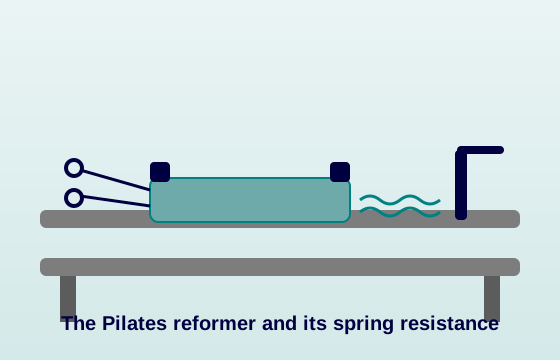
At its heart the reformer is a wheeled platform - the carriage - that glides back and forth along a frame on rails. The carriage is connected to one end of the frame by a set of springs of differing tensions. At that same end sits an adjustable foot bar, while at the other end a pair of long straps with handles run over pulleys. By pushing against the foot bar with the feet, or pulling the straps with the hands and feet, you move the carriage against the resistance of the springs. The springs can resist your effort or, cleverly, assist it - which is what makes the reformer so useful for both the very strong and the very frail.
A single reformer session might flow through dozens of positions - lying, sitting, kneeling, standing and even upside down - all while the carriage keeps the body honest. Because the surface moves, you cannot cheat by locking into a position; the deep stabilising muscles must stay switched on throughout. This constant, subtle demand is why many people feel the work in places they did not expect.
Both forms share the same principles and philosophy, and most teachers recommend doing a little of each. The main differences come down to resistance, support and feedback, as the table shows.
| Aspect | Reformer Pilates | Mat Pilates |
|---|---|---|
| Resistance | Variable springs, easy to fine-tune | Body weight and gravity |
| Support & feedback | High - the moving carriage guides you | Mostly self-directed |
| Range of exercises | Very large and highly adaptable | Large, but less adjustable |
| Rehabilitation use | Excellent - load is easily controlled | Good, with careful modification |
| Where you can do it | Studio only | Almost anywhere |
If you have never used a reformer, the first session is mostly about orientation. A good teacher will settle you onto the carriage, explain the springs and foot bar, and start with simple, grounding movements before building up. Here is roughly how a first class tends to unfold.
Reformer work suits a wide range of people. It is especially valued by those who want precise, well-supported exercise - for example:
A few practical tips help a first visit go smoothly: wear comfortable, close-fitting clothes so the teacher can see your alignment, bring grippy socks if the studio asks for them, and arrive a little early so you are not rushing. Above all, remember that the reformer is there to support you - the springs do a great deal of the work, and nobody expects perfection on day one.
At Rhythm of Life we treat the reformer as one tool among many, always in service of smoother, freer, more intelligent movement. If you would like to try reformer Pilates or combine it with mat and somatic work, get in touch with Kat to discuss the options and find a session that fits your body and your schedule.